


We have homeowners walking into our showroom each week with a real mix of excitement and uncertainty. They know they want a beautiful worktop for their home; however, between the material options, the maintenance questions and the conflicting advice they have found online, the whole process can feel overwhelming before it even begins.
At SharpStone, we understand that every kitchen is different, which is why we feel we should put the most common questions in place, answered honestly and from our experience with the tools and in the showroom.
Whether it’s your first kitchen journey or you are narrowing down your favourite, this is the advice we give our clients every single day.

“Will My Worktop Stain?”
This has to be one of the most frequently asked questions we hear, and the answer depends entirely on the material.
Quartz worktops are non-porous, which means liquids cannot penetrate the surface. Red wine, coffee, olive oil and beetroot juice can all be wiped away without leaving a trace, providing they are not sitting on the surface for an unusually long time. For the vast majority of households, quartz is as close to stain-proof as you can get without any additional treatment.
Porcelain and Dekton, for example, are similarly resistant. They have dense, non-porous compositions that make them incredibly hard to stain, even under heavy daily use. If low maintenance is a priority, these materials consistently deliver on that front.
Natural stone, on the other hand, needs a little more care. Marble, granite, and quartzite are porous to varying degrees, meaning they can absorb liquids if the surface is not properly sealed. Granite is the most forgiving of all three and holds up well with annual sealing. Marble is a softer and more reactive stone, particularly to acidic substances like lemon juice or vinegar. It can be sealed to reduce the risk, but it does require a more attentive approach.
The honest answer we always give is that if you want a surface you never have to worry about, opt for quartz, porcelain or Dekton, which gives you that peace of mind. If you are drawn to natural stone and happy to care for it, the beauty you get in return is absolutely worth it.
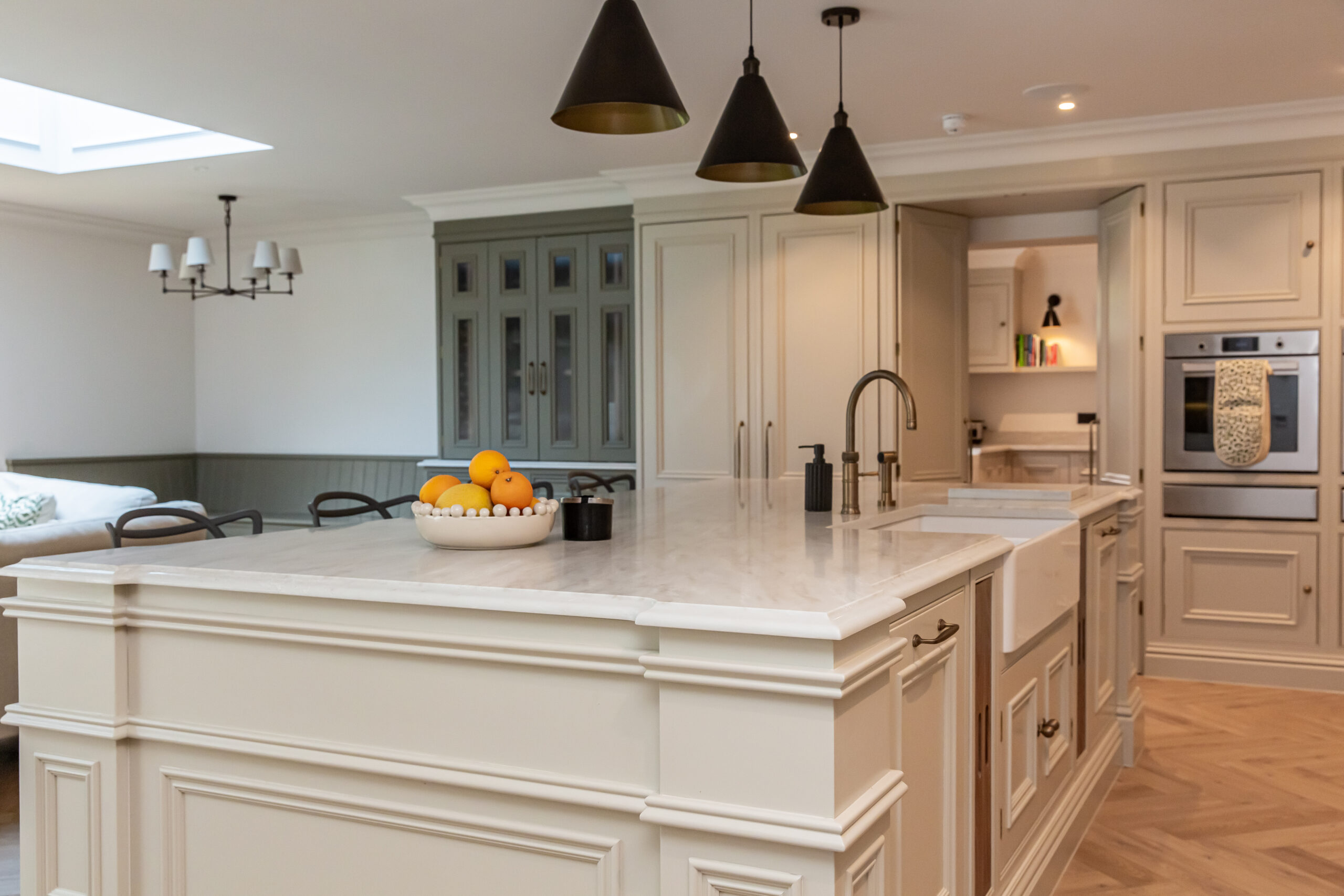
“Can I Put Hot Pans Directly on the Surface?”
We hear this one quite a lot, too, and again, the answer varies by material.
Quartz can handle warm pans and dishes without any issues, but placing a pan straight from the hob or oven is not recommended. The resin used in the manufacturing process can be affected by extreme, concentrated heat, which may cause discolouration or, in rare cases, cracking. We always recommend a trivet or heat mat.
Porcelain and Dekton, however, are a different story. Both materials are exceptionally heat-resistant and can withstand direct contact with hot cookware without damage. This makes them a popular choice for serious home cooks and anyone who wants the freedom to work without constantly reaching for a trivet.
Natural stone generally handles heat well, particularly granite and quartzite, which are formed under intense geological pressure. Marble is more sensitive and can be affected by thermal shock, so a little caution goes a long way.
Our advice to every client is to use a trivet each time. This small habit makes a big difference.

“Which Worktop is Best for a Busy Family Kitchen?”
This is one of our favourite questions to answer because it gets to the heart of how a worktop actually lives, not just how it looks.
For families with young children, the priorities tend to be durability, stain resistance and low maintenance. In that scenario, quartz is hard to beat. It handles spills, scratches and daily chaos without showing signs of wear, and it never needs sealing. A marble-effect quartz worktop is particularly popular with families because it delivers the high-end aesthetic of natural marble without any of the anxiety that comes with it.
Porcelain and Dekton take things even further and are ideal for kitchens that are in use from morning until night. These surfaces are scratch-proof, heat-proof and UV-resistant. If your worktop doubles as a homework station, a baking surface and a breakfast bar all before lunchtime, these materials will take it in their stride.
For families who love the idea of natural stone but worry about practicality, granite is a solid middle ground. It is hard, durable and forgiving, and with regular sealing it performs beautifully in high-traffic kitchens.
The best worktop for a busy family kitchen is one that lets you live without holding back. We always encourage our clients to be honest about how their kitchen functions, and we help them find a surface that matches that reality.

“What is the Difference Between Quartz and Marble?”
This is a question that comes up in almost every consultation, and it is an important distinction to understand because the two materials look increasingly similar but behave very differently.
Quartz is an engineered surface made from roughly 90 to 94 per cent natural quartz crystals, bound together with resin and pigments. This manufacturing process allows for a huge range of colours and patterns, including designs that closely replicate the look of natural marble. Because it is engineered, quartz is consistent from slab to slab, non-porous and extremely low maintenance.
Marble is a natural stone, quarried in slabs and finished by hand. Every piece is unique, with veining and colour variations that cannot be replicated. That’s all part of its appeal; however, marble does require more care. It is softer than quartz, more prone to scratching and etching, and needs sealing to protect against staining.
We help our clients with a material that suits their lifestyle. If you love the marble look but want something you do not have to maintain, marble-effect quartz gives you the best of both worlds. If you are drawn to the authenticity and character of real stone and happy to invest time in looking after it, natural marble is a stunning choice that ages beautifully.

“How Do I Choose the Right Colour and Pattern?”
This is where things get personal, and it is one of the reasons we always recommend visiting the showroom rather than choosing from a screen.
The most important thing to consider is how the worktop will sit alongside the other elements in your kitchen. Cabinet colour is the obvious starting point. A bold, heavily veined worktop works beautifully against simple, understated cabinetry because the stone becomes the focal point. If your cabinets are already making a statement with colour or texture, a quieter, more subtle worktop can balance the room and prevent it from feeling busy.
Lighting also plays a crucial role. A surface that looks warm and golden under showroom spotlights may appear very different in a north-facing kitchen with cooler natural light. We do encourage clients to take samples home, hold them against their walls and cabinets, and see how the stone responds to their own space at different times of day.
It is also worth thinking about the broader mood you want to create. Lighter surfaces with delicate veining tend to make kitchens feel open, airy and calm. Darker tones with dramatic movement bring depth, character and a sense of grounding. Neither is right nor wrong. It simply comes down to the feeling you want when you walk into the room.

“How Long Does Installation Take?”
This is a practical question that comes up towards the end of most consultations, and the answer is usually more reassuring than people expect.
The process begins with laser templating, where our specialist, Jake, visits your kitchen and digitally maps every measurement with pinpoint accuracy. From there, the stone is fabricated in our workshop. Cutting, shaping, polishing and finishing the edges is all done before the worktop arrives at your home, which means the on-site installation itself is relatively quick. Depending on the size and complexity of the layout, fitting usually takes between half a day and a full day.
We will always keep you informed throughout the process, from templating to installation.
What we find reassures homeowners most is knowing that the same team handles the entire process. The people who template, fabricate and install your worktop are all part of the SharpStone team, so there is complete continuity from the first measurement to the final polish.

“Is It Worth Visiting the Showroom or Can I Choose Online?”
We understand the appeal of browsing online, as there is plenty of inspiration. But when it comes to making a final decision, we strongly believe that nothing replaces seeing and touching the stone in person.
Screens can distort colour, flatten the texture, and cannot show you how veining moves across a full slab or how a honed finish feels compared to a polished one. These are the details that influence how a worktop sits in your kitchen every single day, and they are details you can only appreciate when the material is in front of you.
Our showroom is set in the countryside near Harlow and Epping, with free parking and beautiful views. There is always a cup of tea on offer, and Coco will almost certainly insist on greeting you at the door.
Time and again, clients tell us that the showroom visit was the moment their kitchen came together. It is where ideas become decisions and where uncertainty turns into excitement. If you are considering a new worktop, it is well worth the trip.

Related blogs:
A Year On: Why the SharpStone Showroom Still Feels as Luxurious as Ever
First Impressions vs Everyday Living: What Actually Makes a Great Kitchen Worktop
These are the questions we hear the most, but they are by no means the only ones. Every kitchen is different, every homeowner has their own priorities, and no question is too small or too specific.
If there is something we have not covered here, or if you would like to talk through your project in more detail, get in touch or pop into the showroom. At SharpStone, we give honest advice, supply and install beautiful stone, and we have a team that genuinely loves what they do.